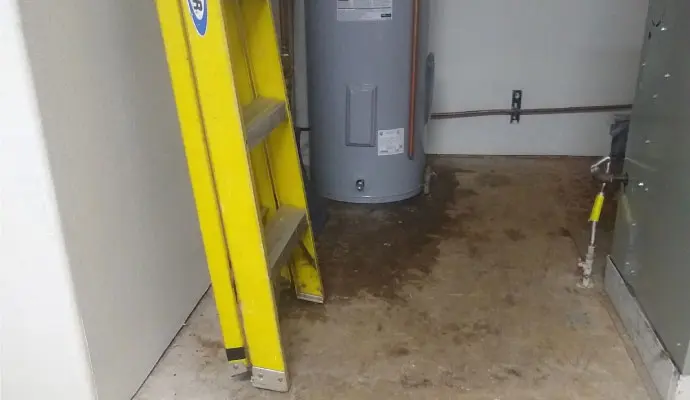
A household tank holds 40 to 50 gallons and refills as fast as it drains. When the tank rusts through or a fitting fails, it can keep releasing water until someone closes the cold supply valve, and in a Glendora garage or hall closet that water heads straight for the slab and the bottom of the walls.
Why water heaters fail in Glendora
Glendora's water is hard. The city's 2021 water quality report lists groundwater hardness averaging 200 mg/L, and that mineral content settles as sediment in the bottom of a tank. Sediment, age and corrosion wear tanks out, and most standard tanks last roughly 8 to 12 years. The USGS page on water hardness explains how those minerals build up.
- A tank that rusts through at the bottom seam
- A leaking temperature and pressure relief valve or its drain pipe
- Loose or corroded supply connections on top of the tank
- A drain valve that drips after flushing
Where the water goes
In a garage, water spreads across the slab, under stored boxes and into the bottom of the drywall on the house side. In an interior closet, it runs under the hallway flooring and into the next room. An attic water heater sends water straight into the ceiling below. The local water damage experts map each path before the equipment goes in.
Water heater leak cleanup, step by step
- The crew confirms the water and the gas or power to the tank are off
- Extraction clears standing water from the slab and flooring
- The team moves wet boxes and stored items out and sets them aside
- Baseboards come off and lower drywall opens where readings stay high
- Air movers and dehumidifiers run until the slab and walls read dry
The Energy Saver program covers water heater care, and slab leak water damage covers leaks that start under the floor instead.