In La Verne, the city runs the water system itself. That makes the water meter the point where responsibility changes when a pipe bursts: some equipment belongs to the city, and some belongs to the owner.
Key takeaways
- The city runs its own water system through its Water and Utility Division, which operates the water production and distribution facilities and reads and maintains the meters.
- Under the municipal code, a valve the city installs on the consumer's side of the meter becomes the consumer's property, maintained and replaced at the consumer's expense.
- Services and meters the city installs stay city property, and the city pays for repair and renewal from normal wear.
- Any expense from a willful or negligent act of the consumer is charged to the consumer.
- The first step in a burst pipe is closing the right valve, so it helps to know where it is before an emergency.
The city runs the water system
The City of La Verne provides water through its Water and Utility Division, which operates and maintains the water production and distribution facilities and reads and maintains the water meters.
The water comes from eight municipal wells that pump from the Pomona and Live Oak groundwater basins, blended with imported water at booster stations. The city buys that imported water from Three Valleys Municipal Water District.
The division operates the system and maintains the meters. Plumbing on the property is a separate matter, and a water damage restoration team deals with what a failure there leaves behind.
What the municipal code says about valves and meters
The code sets out who owns what on either side of the meter. The list below follows its wording closely.
- Shut off valves, curb stops and corporation stops are installed by and for the use of the city.
- A valve the city installs on the consumer's side of the meter becomes the consumer's property, maintained and replaced at the consumer's expense.
- Services and meters installed by the city remain city property.
- The city pays for repair and renewal due to normal wear.
- Expense from a willful or negligent act of the consumer is charged to the consumer.
What the code does not say
The code speaks to city services and meters. A burst pipe inside the home is a plumbing and cleanup matter for the owner.
Finding the right valve before a pipe fails
Two valves matter in an emergency. The main valve where the supply pipe enters the house stops water to everything inside.
A valve on the consumer's side of the meter, if the property has one, does the same from outside.
- Find the main valve where the supply pipe enters the house, and make sure everyone in the household knows where it is.
- Look for a valve on the consumer's side of the meter, and test it so it is not stuck.
- Curb stops and corporation stops are installed for the city's use, so the owner's own valve is the one to close.
- Label the valves with a tag so a guest or a tenant can find them quickly.
- Keep the area around each valve clear of boxes, plants and stored items.
A stuck valve
A valve that will not turn fully is worth a plumber's visit, because on the consumer's side it is the owner's to maintain and replace.
Why age matters
The median home here was built in 1976, and about 7,454 of the city's 12,020 homes were built before 1980. A valve that has sat untouched for decades can seize, and finding that out during a burst pipe is the wrong moment.
Turning each valve gently once a year, then returning it to the open position, keeps it from locking in place.
How a supply pipe fails
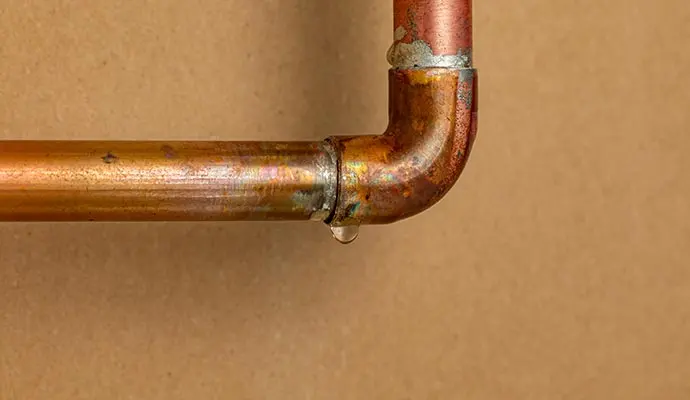
Most burst pipe losses start small. A fitting works loose, a pinhole opens or a section of pipe splits, and the water that follows depends on how long the supply stays on.
A pinhole can run for weeks behind a wall before paint bubbles, which is why a sudden jump in the water bill, a hissing sound or damp drywall is worth a look.
- Fitting failure: a joint or connector that corrodes or works loose.
- Pinhole: a tiny opening in the pipe wall that sprays or seeps inside a wall or ceiling.
- Split: a crack along the pipe that can release a large amount of water quickly.
- Appliance connector: a supply hose to a washer, dishwasher or ice maker that bursts.
First steps once a pipe bursts
Closing the valve stops new water, and every other step follows from that. Burst pipe water damage begins with the same order.
- Close the main valve or the valve on the consumer's side of the meter.
- Open a faucet at the lowest point of the house to drain the pipes and ease pressure.
- Turn off power to wet areas if the panel is dry and can be reached safely.
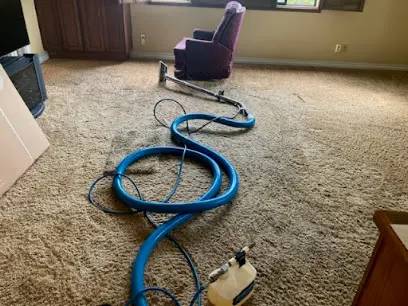
- Move belongings out of the wet area and lift furniture off wet carpet.
- Photograph the burst, the wet areas and the meter.
What extraction and drying involve
Water from a burst supply pipe starts out clean, but it does not stay that way once it soaks into carpet pad, insulation and drywall. The restoration team removes standing water first, then measures moisture in walls, ceilings and floors.
Water extraction comes before drying, and the equipment stays until the readings match a dry reference.
Records for the repair
A burst pipe usually involves a plumber, a restoration team and sometimes the city, so a short record keeps everyone working from the same facts.
- Photographs of the burst pipe, the wet areas and the meter.
- Which valve was closed, and when.
- The plumber's findings and the repair that was made.
- Copies of the moisture readings from each drying visit.
- A list of damaged flooring, furniture and belongings.
Questions
Who maintains the shut off valve on the consumer's side of a La Verne water meter?
Under the municipal code, a valve the city installs on the consumer's side of the meter becomes the consumer's property, maintained and replaced at the consumer's expense.
Who owns the water meter?
Services and meters installed by the city remain city property, and the city pays for repair and renewal due to normal wear.
What happens if a consumer damages the meter or service?
Under the code, any expense resulting from a willful or negligent act of the consumer is charged to the consumer.
Where does the city's water come from?
Eight municipal wells pump from the Pomona and Live Oak groundwater basins, and well water is blended with imported water bought from Three Valleys Municipal Water District.
Which valve should be closed in a burst pipe?
The main valve where the supply pipe enters the house works, and so does a valve on the consumer's side of the meter, if the property has one. Closing either stops water from entering the home.
Should extraction wait until the plumber finishes?
No. Closing the valve stops new water, and extraction can start at once, because standing water spreads and soaks into more materials the longer it sits.