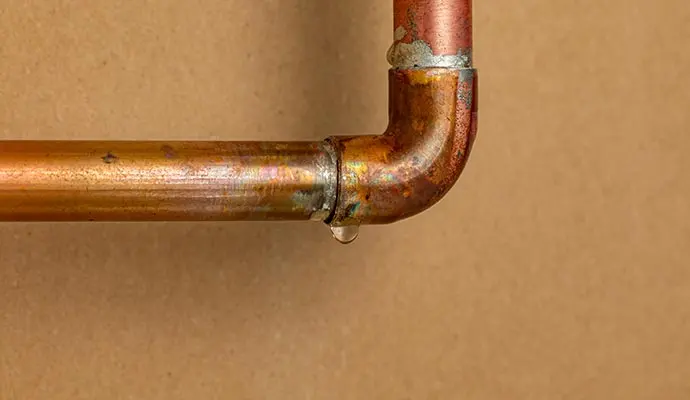
A burst pipe moves quickly because supply pipes stay under pressure until someone closes a valve. Water runs down wall cavities, drips through ceilings and spreads under flooring while the surface still looks nearly normal. Speed matters, but the first valve matters more, because closing the right one stops the loss.
What a burst looks like inside the building
Damage usually follows one of these paths, and a moisture map shows which of them apply:
- Down the wall cavity to the baseboard and the floor below.
- Through the ceiling when the pipe runs above a finished room.
- Into insulation, which holds water against the drywall.
- Under cabinets and vanities where plumbing enters the wall.
- Across subfloors, then out to hallways and neighboring rooms.
Age and the San Dimas housing stock
San Dimas counts about 12,370 homes, and roughly 7,826 of them predate 1980. Fittings, supply connections and fixtures that have served for decades wear out, and a slow weep at a joint can become a full burst when a connection finally gives way. Older fittings are only one cause, but they are worth checking while the walls are open.
Shutoffs and the utility service area
Golden State Water Company runs the San Dimas Customer Service Area, which also covers Charter Oak, Covina, Glendora, La Verne and Walnut. Every property still needs a main shutoff that a household member can find and turn. Knowing where it sits, and testing that it moves, saves more damage than any other step. After the water is off, water extraction and structural drying finish the job.